
The Anatomy of Creative Work
I can see it in my artist friends and in the ones who swear they don't have it. The difference was never ability. It was the title, and what it costs.
I have artist friends and I have regular friends, and I can see it in both of them. Even the ones who insist they don't have it.
Most people ignore it, or tap into it occasionally without ever calling themselves creative. Because once you claim it, everything you make becomes evidence both for and against it.
Take the title and you make yourself vulnerable to a very specific kind of criticism.
"That's not art, that's garbage."
"My four year old could do that."
It's a leap. And most people would rather watch you miss.
The difference shows up when someone asks what you do.
Artists adopt it as a title. Everyone else keeps the ability and leaves the label alone, or detaches from the idea entirely.
As in, "Oh I can't draw, I'm not creative."
So how do you tap into it?
I'd break this into three:
The same patterns surface in places that share no tools at all. A photographer, a developer, a chef plating a dish. Different materials, identical problems.
My question is this: Does creativity have limbs? Parts you could examine, name, and train?
I think it does. That's the thesis, at least. What follows is my attempt at the creative anatomy.
First, what makes it different from every other kind of work.
No Rulebook, No Finish Line, No Prize
Every other kind of work comes with a set of rules and outcomes. Follow the method and you get a result someone else can verify. Miss, and there's a step you can blame.
Creativity hands you absolutely none of that.
I think that's why people get weird about it.
Creative work shows people something they've hidden from themselves: that they wanted to make something too, and didn't. Some of them call it garbage and move on, which is the same reaction wearing a different face.
Other artists read it as competition, though they'll give you flowers if the work is good.
A few see exactly what you were reaching for. And it will land with them, somewhere under the surface where reasoning doesn't quite reach.
I think that's the truth of it. Art or creativity as a language between souls.
A Language You Can Be Fluent In
If it's a language, the question changes. It stops being whether you have it, which was never really in doubt, and becomes how much of it you can speak.
That version has an answer you can work on.
Let's consider learning a second language. At first you're using words as blocks. Characters, sounds, then sentences. It's slow. Clunky. You're thinking in your native language and converting.
Then at some point you stop converting. You start thinking in the new one.
Chomsky drew the line between competence and performance in 1965: competence is knowing the grammar, performance is actually speaking.
Most creative tools teach performance and skip competence. They show you how, without ever telling you why it works.
So most people stay stuck converting. What tool fixes this. Which tutorial covered that.
Fluency is when you stop reaching for a tool and start seeing the parts. More than one way into the problem. You can turn it over. Solutions stop needing to be forced.
They just.. emerge.
Which isn't magic. Every language has an anatomy. Sounds, then words, then grammar. Nobody identifies those before they speak. But everybody had to learn them first.
So what are the parts of this one?
The Seven
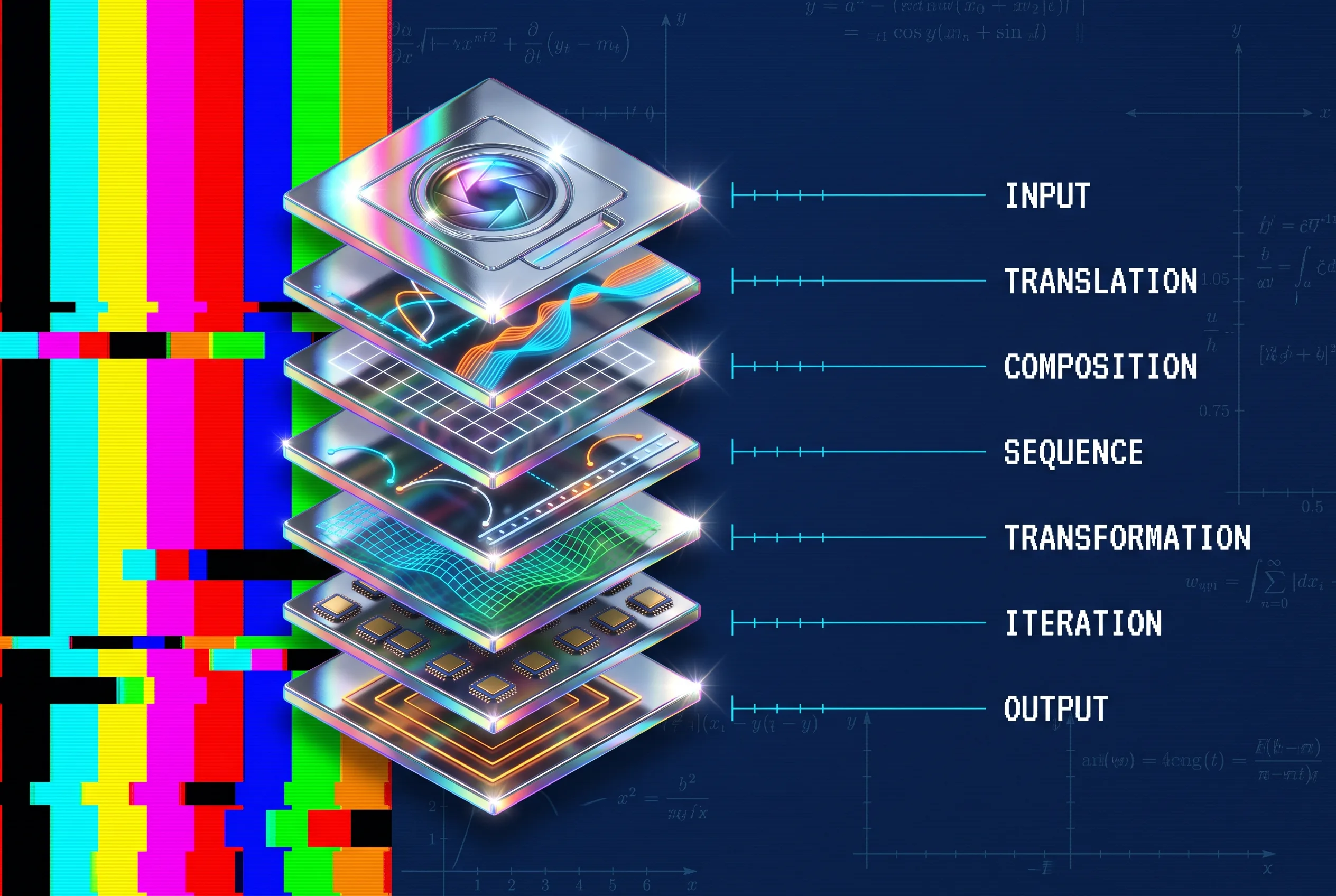
They're ordered the way the work runs. Catch it, translate it, arrange it, time it, change it, repeat it, ship it.
You already do all seven. What most people can't do is say which one they're standing in when it stops working.
01Input
Getting ideas out of your head and somewhere you can find them again. Screenshot automation, annotation, voice to text, recording your own process.
The most underrated of the set, and the reason it goes first. Everyone talks about output. But the capture layer decides what you have to work with at all.
Also called. Collection, capture, intake, sourcing, field notes, reference gathering, research, discovery, observation, sampling, scouting, the commonplace book. Science calls it data collection. Journalism calls it reporting. Kitchens call it sourcing.
In practice. Screenshots, swipe files, mood boards, voice memos, transcripts, annotations, bookmarks, clippings, tagging, taxonomies, highlights, morgue files, reference libraries, inbox capture, daily notes, screen recording.
Tools. Obsidian, Notion, Readwise, Are.na, Eagle, PureRef, CleanShot X, Shottr, Raycast, Otter, Zotero, Craft, Arc, Milanote.
02Translation
Turning one thing into another. Numbers into narrative. Images into palettes. Feelings into search terms.
Same word as the language section above, and not by accident. Almost everything interesting turns out to be a translation problem. You have information in one form and need it in another, and things that looked like design problems keep turning out to be translation problems.
And it isn't only creative work. Medicine translates symptoms into diagnoses. Law translates behavior into precedent. Moving fluently between representations might be the most valuable skill nobody teaches directly.
Sometimes the translation makes something that wasn't there before. Chart the numbers and a pattern shows up that the numbers never showed you. Nothing got added. The change of form did it.
Also called. Mapping, encoding, interpretation, transcription, notation, visualization, abstraction, modeling, sense-making, data conversion. Medicine calls it diagnosis. Law calls it precedent. Music calls it transcription.
In practice. Data visualization, information architecture, color extraction, palette generation, semantic search, embeddings, tagging schemas, charting, wireframe to code, brief to concept, transcription, sonification, parametric input.
Tools. Observable, D3, RAWGraphs, Flourish, Datawrapper, Airtable, Supabase, Coolors, Adobe Color, Khroma, Perplexity, Whisper, Claude.
03Composition
Where things go and how they relate. Layout logic, component libraries, layering and hierarchy.
The most traditional one, and sneakier than it looks. Composition is really about relationships, and the space between things carries as much as the things.
It's also the part people feel before they can name. Something's off, they'll say, and they can't point at what. Usually it's distance. Two things sitting closer than the relationship between them deserves.
Also called. Arrangement, layout, staging, blocking, framing, orchestration, structure, form, proportion, balance. Architecture calls it plan. Film calls it blocking. Music calls it arrangement. Writing calls it structure.
In practice. Grid systems, hierarchy, whitespace, typographic scale, rhythm, alignment, contrast, figure and ground, rule of thirds, modular scale, design tokens, component libraries, layering, spatial relationships.
Tools. Figma, Sketch, Penpot, Framer, Tailwind CSS, Radix, shadcn/ui, InDesign, Fontshare, Google Fonts, Type Scale, Utopia, Spline.
04Sequence
What happens first, and what that sets up. The cut, the hold, the reveal. Typography that arrives a beat before the line it belongs to.
I used to file this under motion, as in making things move. That isn't it. It's deciding the order things arrive in, which is a different job entirely, and the one that took me longest to see.
Also called. Timing, pacing, rhythm, tempo, cadence, choreography, motion, progression, reveal. Film calls it editing. Music calls it tempo. Comedy calls it timing. Narrative calls it plot. Kitchens call it courses.
In practice. Storyboarding, keyframes, easing curves, transitions, beat mapping, scene flow, reveals, loops, anticipation and follow-through, kinetic type, scroll-driven sequence, hold times, cuts.
Tools. After Effects, Rive, Lottie, GSAP, Motion, Remotion, DaVinci Resolve, Premiere Pro, Cavalry, Jitter, Theatre.js.
05Transformation
Changing form while preserving or destroying meaning. Style transfer, texture, generative systems, parametric rules that produce forms.
This is the one that feels like magic when it lands. You run something through a conceptual filter and what comes out is recognizable but altered. Sometimes better. Sometimes just.. different in the way you needed.
It's also the easiest place to hide. Run something through enough filters and it starts to look resolved without anyone ever having decided anything.
Also called. Mutation, variation, adaptation, remix, reinterpretation, treatment, processing, distortion, metamorphosis. Music calls it sampling. Biology calls it mutation. Kitchens call it technique. Translators call it adaptation.
In practice. Style transfer, texture and material, generative systems, parametric rules, procedural geometry, filters, shaders, displacement, collage, glitch, sampling, image to image, LUTs, grading.
Tools. Photoshop, Blender, TouchDesigner, Cables, Houdini, ComfyUI, Stable Diffusion, Midjourney, Runway, Substance 3D, p5.js, Processing.
06Iteration
Doing it again, faster, differently. Batch processing, prompt templating, version control for visuals.
I used to think this was the game. That enough automation would make creativity scale. It does, partly. But repetition without the other components is just.. fast mediocrity. Took me a while to notice.
Also called. Repetition, drafting, versioning, studies, rehearsal, practice, batching, automation, systematization, tooling. Painters call them studies. Musicians call it rehearsal. Engineers call it CI. Science calls it replication.
In practice. Batch processing, templates, presets, actions, macros, scripts, pipelines, version control, variants, generative batches, naming conventions, design systems, cron jobs, reproducible builds.
Tools. n8n, Zapier, Make, GitHub Actions, ffmpeg, ImageMagick, Claude Code, Cursor, Git, Python, Notion API, Raycast.
07Output
Getting work into the world, and in front of the people it was made for. Distribution, prototypes, asset pipelines, multi-format export.
The unglamorous one, and great work dies here constantly. Wrong format, wrong context, wrong sequence.
I've lost more work at this stage than anywhere else. Never to a bad idea. To a bad export, or the right thing sent on the wrong day.
Also called. Delivery, release, publishing, shipping, distribution, handoff, export, deployment, presentation, exhibition. Film calls it distribution. Software calls it deploy. Galleries call it the hang.
In practice. Asset pipelines, multi-format export, compression, color profiles, aspect ratios, responsive variants, packaging, handoff specs, prototypes, decks, scheduling, platform-native crops, archival masters.
Tools. Vercel, Netlify, Cloudinary, ffmpeg, HandBrake, Squoosh, ImageOptim, Webflow, Framer, Ghost, Substack, Buffer, Descript.
What the Anatomy Is For
An anatomy doesn't tell you what to make. It tells you what the thing is made of.
Every finished thing runs the whole loop, though most lean hard on four or five. A photograph leans on input, composition, transformation, output. A landing page pulls in sequence and iteration too. A plated dish works all seven, if you count the sourcing.
Practicing professionally mostly means doing it on demand. Someone else's problem, someone else's deadline, no waiting for the mood to show up. Knowing the parts is what lets you start anyway.
It also tells you where to look when the work stops. You keep pushing on the layout and it won't come together, but there was never enough raw material to arrange in the first place. That's input, not composition.
It's almost never the part you're staring at. Usually it's the one you missed before it.
Is Any of This Real?
Does naming the components help, or does it just intellectualize something good creatives already do without thinking?
The best designers I know don't stop and think, ah, a translation challenge layered with composition.
They just do it. The fluency is invisible to them, which is more or less what fluency is.
So maybe I'm reverse engineering my own intuition and putting labels on it so it feels more legitimate.
Honestly.. probably some of that.
But I'd rather have the words and not need them than be stuck without a map.
It also makes the title easier to claim. You don't need to feel like an artist to run seven parts.
You just need to know which part you're in.
Your Take on the Creative Anatomy
So don't take this as a set list.
Take the last thing you made and look at it this way. Maybe you find the same seven. Maybe you find fifteen. Maybe your anatomy is a different species entirely.
All of which is fine. This is an attempt to give structure to something that showed up without a rulebook, so we can get better at the craft. Which could mean becoming fluent in a language best understood soul to soul.
> More from the Index
All posts →
> Get posts like this
Keep the thread going.
New pieces land here first. No schedule, no noise, just the ideas worth the room in your inbox.
- Essays on attention, craft, and building
- What I got wrong, with the receipts
- The occasional teardown of something I built
Unsubscribe anytime · No spam
.gif)
> ReturnSend
Subscribe Now.
Wake up curious. The work, the art, and the ideas underneath. Occasional, personal, and only when there's something worth sending.