
The Rules of the Game
Your ceiling is a belief. Notice what people protect. Whoever can walk away sets the price. Twenty-three patterns, and which ones I might have wrong.
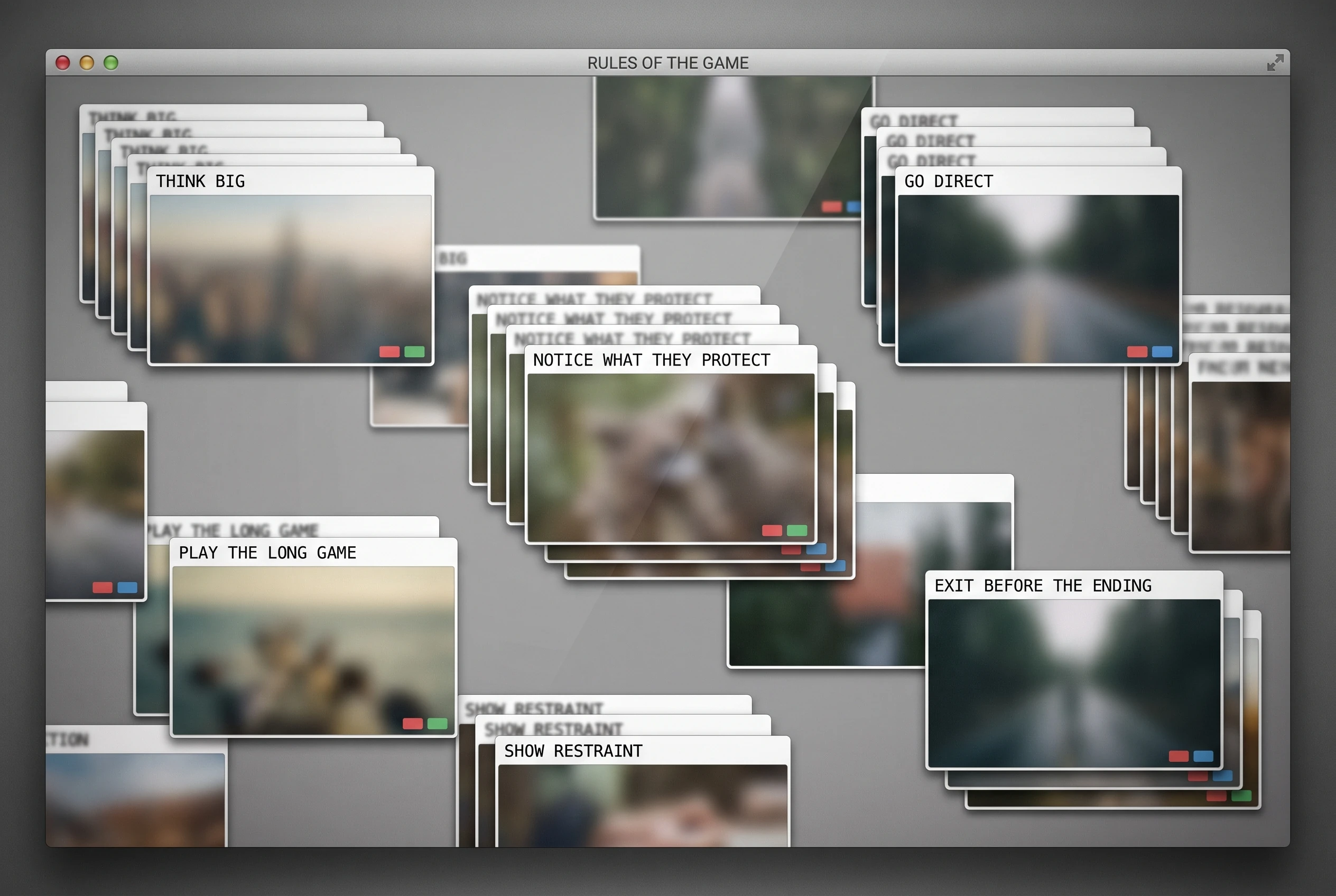
Feels a lot like 48 Laws of Power, but sort of different. Robert Greene wrote 48 laws and made power legible. These aren't that clean. These are messier. Probably less useful. And I can't blame him when they don't work.
Everyone is playing, whether they like it or not.
Maybe there are rules, maybe there aren't. I've been collecting these for a while. Some of them came from books or podcasts, sure. But mostly from watching. Paying attention to what actually happens versus what people say happens.
Some of these I'm sure about. Some I'm still testing. A couple I might be wrong about entirely.
Twenty-three of them so far. The ones near the top are the ones I'd defend hardest.
The Ones That Keep Coming Back
These are the ones I don't question anymore. They've held up too many times.
01Your ceiling is a belief, not a fact.
Sounds like a poster in a gym lobby. But I've watched it work in reverse too many times, people who think small and then wonder why everything stays small. Your ceiling is a belief system. I really think that's true. I watched a friend turn down a pitch because he thought it was "too ambitious for someone like us." The pitch would've landed. I know because someone else made it six months later.
02Almost all of it is noise.
Everything else is noise. And the noise is loud. The noise has its own Instagram account and a newsletter and a Discord server.
03One good thing beats four adequate ones.
I learned this the hard way. Built like four things at once in 2023 and none of them were good. Not bad. Just.. not good. The difference between "not bad" and "good" is the difference between being forgotten and being remembered.
04Know what your time costs.
Not in the hustle-culture, sleep-when-you're-dead way. More like: know what your time is worth and stop giving it away for free. Every yes to something pointless is a no to something that matters.
The Strategy Ones
These feel more like game theory than life advice. And I'm okay with that.
05Available is not the same as valuable.
Scarcity isn't a trick, it's just math. Robert Cialdini wrote about this in Influence, the scarcity principle. Things become more desirable when they're less available. Not because they're actually better. Because that's how human brains are wired. The thing that's always there stops being valued.
06Curiosity travels further than comfort.
Comfort is forgettable. Curiosity is a door that stays open. I tested this with a cold email last year. Sent one version that was polite and thorough, another that just asked a weird question about their business. The weird question got a reply in twelve minutes. The polite one is still sitting in someone's inbox probably.
07Know who benefits from you not knowing.
I don't mean this in a paranoid way. Mostly. Just know what you're walking into. Know who benefits from you not knowing.
08Direct is cheaper than polite.
This one took me years. I used to soften everything, the ask, the pitch, the feedback. Turns out people respect direct more than they respect comfortable. The indirect route feels safer but it's actually more expensive.
09Whoever can walk away sets the price.
I'm not sure this one's always true. Or maybe I just don't want it to be true, because I care about almost everything too much and that's probably a problem. But in negotiations? In business dynamics? Yeah. The person who can walk away usually wins.
That doesn't mean you shouldn't care. It means you should be able to walk away from things that don't serve you. There's a difference. I think.
The Awareness Ones
Less about doing. More about seeing.
10The losses are more honest than the wins.
The wins teach you what's possible. The losses teach you what's real. I pay more attention to the losses honestly. People don't fake those.
11Notice what they protect.
This one is so reliable it's almost scary. You can learn more about a person from what they guard than from what they show you. What someone hides tells you what they value. What they defend tells you what they fear.
12If you aren't invited, don't ask to go.
This sounds harsh and maybe it is. But I've been on both sides of it, being the person who wasn't invited and being the person who watched someone ask. Neither feels good. There's a version of this that's about self-respect more than strategy. Know where you're wanted. Go there.
13You don't have to be understood in real time.
Still learning this one. My instinct is to explain, justify, add context. But the people who are really good at this, at holding space without filling it, they move different. There's a power in not needing to be understood in real time.
The Wild Cards
These are the weird ones. The ones that don't fit neatly into business strategy but keep proving themselves anyway.
14Let them anchor first.
Classic. Probably in every business book ever. But it works. Let them anchor and then adjust.
15People price you before you speak.
Not "wear expensive things." Just look like you thought about it for more than zero seconds. People decide what you're worth before you open your mouth. That's not cynical, it's just observation.
16Carry cash.
I don't even fully know why this one stuck with me. Something about being ready. About not being dependent on systems working. Maybe it's just superstition at this point. But I keep doing it.
17If you drink, don't blame the alcohol.
You said it. You did it. The drink didn't make you a different person, it made you a louder version of who you already were. Own it.
18Anger is information, not a weapon.
The moment you lose control, you've given someone else the power. Anger is information. Use it like information, not like a weapon you grabbed without thinking.
19Commit all the way or don't start.
If you're going to commit to something, commit all the way. The half-attempt is worse than not trying. At least "I didn't try" is honest. "I kind of tried" is just.. sad.
The Long Game
20Solo has a ceiling, and it's lower than you think.
I resisted this one for a long time. Thought I could do it all myself. Was wrong. The ceiling of solo is real and it's lower than you think. The people who scale aren't smarter, they just stopped trying to be everything.
21Build the system, not the task.
Not hoard, multiply. Make the thing work harder than you do.
I keep coming back to this. Spent a whole weekend once building an automation that saved me twenty minutes a day. Felt stupid at the time. Six months later that's sixty hours back.
22Most people quit before it compounds.
Naval Ravikant talks about how the returns on long-term thinking are invisible for years and then suddenly obvious. Compounding. Not just money. Relationships, skills, reputation. All of it compounds if you let it.
And everyone else is tired. And they'll burn out. And they'll pivot. And they'll quit. The person still standing in three years wins by default. Not by being better. By being there.
23Make your exit before the ending.
Leave when it's good. Not when it's falling apart. This applies to parties, jobs, partnerships, conversations. The exit is part of the performance. Most people don't think about it until they're already on the way down.
Maybe
Might add more. Might edit. Might delete half of these in six months when I realize I was wrong about them.
That's kind of the point though. These aren't commandments. They're just patterns I keep noticing. And the ones that stick around long enough.. maybe those are the real ones.
Or maybe I'm just pattern-matching noise into meaning because that's what humans do.
Idk.
> More from the Index
All posts →


> Get posts like this
Keep the thread going.
New pieces land here first. No schedule, no noise, just the ideas worth the room in your inbox.
- Essays on attention, craft, and building
- What I got wrong, with the receipts
- The occasional teardown of something I built
Unsubscribe anytime · No spam
.gif)
> ReturnSend
Subscribe Now.
Wake up curious. The work, the art, and the ideas underneath. Occasional, personal, and only when there's something worth sending.