
Get to Rejection
I had a spreadsheet of 200 influencers and sat on it for three days. Not because the pitch was bad. The rejection I feared barely existed.
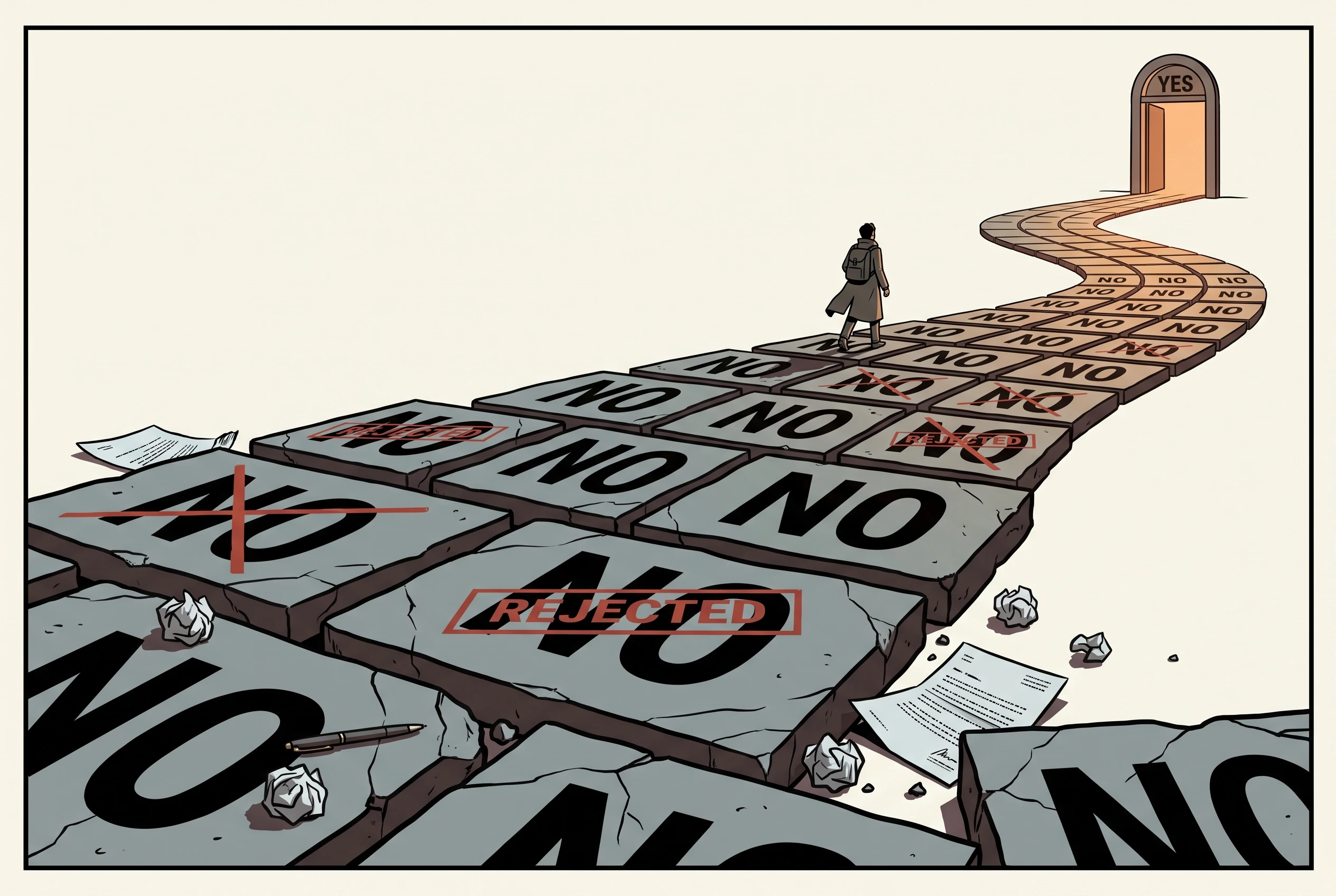
I had a spreadsheet of 200 influencers.
Names, follower counts, content style, engagement rate. Segmented by niche. Color-coded by priority. The whole system.
This was for a client, SpaceLVN, a luxury property brand in Las Vegas. The pitch was tailored experiences at high-end houses. Not "come stay here and post." More like: we design something around your content, your audience, your vibe. The houses become sets, studios, backdrops for whatever world the creator is building.
Good idea. Real idea.
And I sat on it for three days.
Refining Is Just Stalling With a System
Not because I didn't believe in it. I did. The pitch was solid, the properties were nice, the concept made sense for both sides.
I just didn't want to hear no.
That's the honest version. The strategic version is "I was refining the outreach sequence" or "optimizing the segmentation."
Because the moment you send the first cold DM, you're no longer in the safe zone of planning. You're in the zone where someone can look at what you made and go.. nah.
And that's a different feeling entirely.
Jia Jiang spent 100 days deliberately seeking rejection from strangers, asking for impossible things just to feel the no. His insight wasn't about becoming fearless. It was that most rejection is softer than the version your brain invents beforehand.
I hadn't read his book yet when I was sitting on that spreadsheet. But I was living the exact thing he was studying.
What Happened When I Actually Started Sending
When I finally started sending, like actually hitting send, not drafting and redrafting, something weird happened.
The first few were the hardest. Obviously. You're watching the "seen" notification like it's a verdict. Someone opens your message, doesn't respond, and your brain writes the whole story. They think it's spam. They think I'm nobody.
Naomi Eisenberger's fMRI research showed that social rejection lights up the same brain regions as physical pain. Literally the same wiring. So when your chest tightens before pressing send on cold outreach, that's not weakness. That's wired into your nervous system.
But by message 15 or 20, something shifted. The weight of each send got lighter. Not because I stopped caring, but because the volume diluted the stakes. Any single rejection stopped being a referendum on me and started being just.. one data point in a spreadsheet.
Which is what it always was. I just couldn't see it when there was only one row.
Most of It Isn't Even a No
Most of the fear of rejection isn't a no. It's silence. A "seen" with no reply. A "sounds cool, let me think about it" that evaporates.
And then every once in a while someone responds with genuine interest and you realize the 40 people who didn't respond weren't rejecting me. They were just busy. Or it wasn't their thing. Or they didn't check DMs that day.
Chet Holmes called this the Dream 100, disciplined repetition on the right targets beating any single perfect pitch. The pitch didn't need to be perfect. It needed to be sent. Repeatedly.
A few influencers came back interested. Real conversations about the properties, the concept, what collaboration would look like. And those conversations only happened because I'd already burned through the discomfort of the 30 messages before them.
Richard Fenton wrote Go for No!, where the premise is that top performers set rejection quotas instead of success quotas. Increasing the rate of no mathematically increases the rate of yes. Which sounds obvious in theory. But when you're staring at a cold DM draft at 11pm it doesn't feel obvious at all.
Speed Is the Only Thing That Shrinks It
The SpaceLVN project taught me something I keep relearning. The fear of rejection is almost always bigger than the rejection itself. And the only way to shrink it is to move through it with speed.
Not slowly. Not carefully. Fast.
Because when you're moving fast, you don't have time to build a story around each no. You just log it and send the next one. And somewhere in that rhythm, the flinch starts to fade.
It doesn't disappear. I still feel it. Every cold outreach, every pitch, every time I put something in front of someone who could say no, there's a version of me that wants to go back to the spreadsheet and refine the segmentation for another day.
But I know what that is now.
Is Confidence the Absence of Fear, or Just Faster Recovery?
I wonder sometimes if people who seem fearless about putting themselves out there actually feel less of that flinch, or if they've just gotten so used to moving through it that it barely registers.
Martin Seligman would say the second. His work on learned optimism is that resilience isn't personality, it's a skill. You build it the same way you build any system. Which means getting over rejection isn't something you're born with. It's something you train through.
And maybe that's what sitting on a spreadsheet for three days teaches you. The skills were there. The pitch was ready.
The thing you're avoiding isn't the no. It's finding out what you're worth when someone has the option to say it.
If you're staring at a list of people you should've messaged last week, send the first one. The worst version of no is almost always quieter than the version in your head.
> More from the Index
All posts →


> Get posts like this
Keep the thread going.
New pieces land here first. No schedule, no noise, just the ideas worth the room in your inbox.
- Essays on attention, craft, and building
- What I got wrong, with the receipts
- The occasional teardown of something I built
Unsubscribe anytime · No spam
.gif)
> ReturnSend
Subscribe Now.
Wake up curious. The work, the art, and the ideas underneath. Occasional, personal, and only when there's something worth sending.